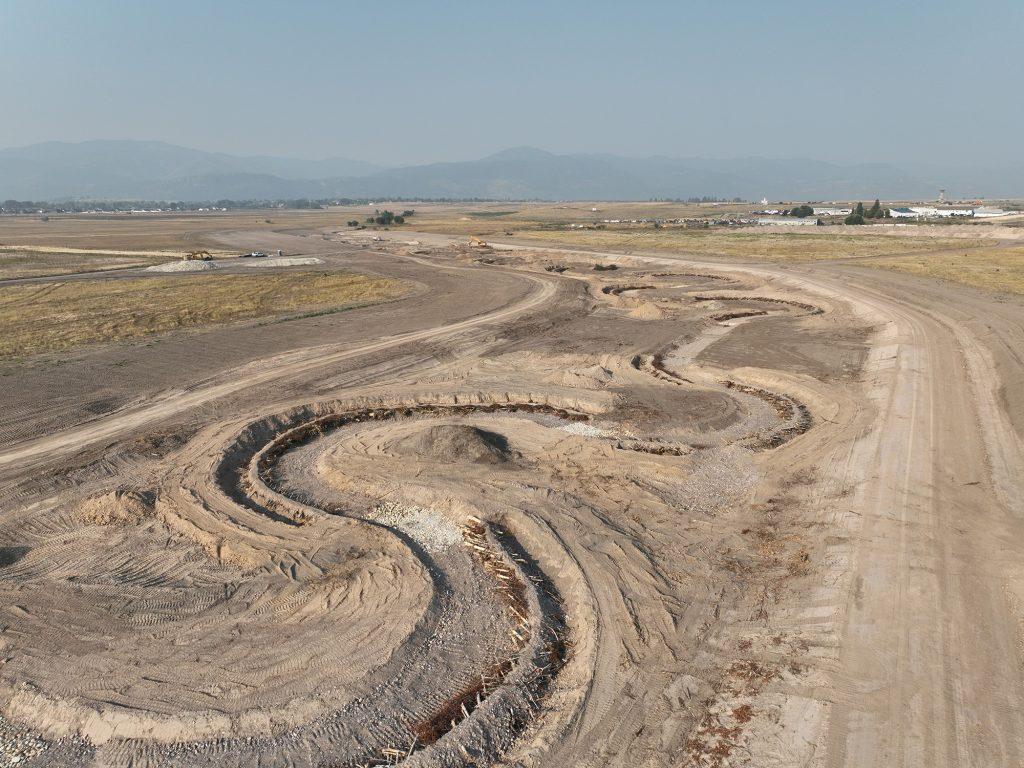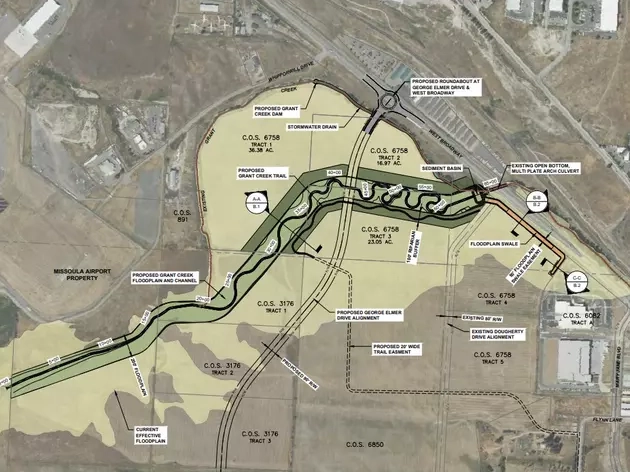
Mountain Line, Missoula’s zero-fare transit agency, had outgrown the facility it had used for more than four decades. Backed by a $39.1M federal grant, the agency is building a new Maintenance, Operations, and Administration Base (MOAB) on an 18.5-acre site near the Missoula airport and the newly restored Grant Creek. DJ&A led the stormwater analysis for the site and its public access roads, which are among the city’s most constrained stormwater settings. Several challenges affected the project: the site remained regulated as a floodway, the airport prohibited open water, surface soils drained poorly, and neighboring parcels that would share the system had no development plans. DJ&A designed an enclosed underground regional facility to treat runoff, infiltrate smaller storms, and release larger storms at or below pre-development rates, protecting the creek as the area grows.
Why the System Went Underground
Regional stormwater in Missoula typically relies on open detention basins or drywell sumps. DJ&A tested both, along with a bioswale through the roadway boulevards, and each failed for a different reason. Surface soils were too poor for drywells, and the bioswale didn’t fit the city’s maintenance plan. An open basin would have sat within 10,000 ft. of jet operations at the airport, where FAA guidance treats standing water as a wildlife attractant and a hazard to aircraft. Because the realigned creek’s outfall sits above the pipe network, a basin would also have held a permanent pool with no way to drain.
DJ&A designed an enclosed facility built from five runs of 108-in. corrugated metal pipe, holding roughly 110,000 cu. ft. of storage. Supplemental testing at facility depth found gravels that accept water quickly, enabling deep infiltration. The system is designed to drain the water quality volume in under five hours, well within the city’s 72-hour requirement. A regional, enclosed infiltration and treatment facility serving several future owners, under public ownership, is new to Missoula.
Sized for Today, Ready to Grow
Most of the drainage area had not been zoned, funded, or designed, so DJ&A modeled it twice. One analysis sized the facility for the funded project. A second, coordinated with 406 Engineering, the engineer for the adjacent development, modeled the full buildout.
DJ&A oversized the facility about 10 percent for flexibility and built in a defined expansion path. Pipe sections at the end of each barrel let a future contractor extend storage without disturbing the inlets. The area set aside could hold roughly 359,000 cu. ft., more than the entire 100-year runoff volume of the developed area. The pipe network and separators were sized for full buildout from the start, since upsizing buried pipe later is far more disruptive. Neighboring parcels can tie in through stubs DJ&A provided, so each future lot avoids building its own basin.
Key Services
- Stormwater Engineering Report
- Hydrology and Hydraulics
- Water Quality Treatment Design
- Floodplain Permitting
- Survey
- Structural Engineering
- Landscape Architecture
- Stakeholder Coordination
Value Added
Runoff from a transit maintenance site carries sediment, hydrocarbons, and floatables. DJ&A’s treatment train runs flow through Envirohood pretreatment and two Contech CDS hydrodynamic separators, sized to meet Washington State’s TAPE standard, before it infiltrates or discharges. The water quality volume and 2-year storm soak into the ground, and larger storms release at or below pre-development rates, so the restored creek sees no added flow. A flap-gated outlet prevents the creek from backing into the system during floods, and an emergency overflow path keeps the system working if the primary control is blocked.
DJ&A also saved time on permitting. With FEMA still regulating the site as a floodway, the project required a no-rise demonstration, so the team used the hydraulic model already approved in the city’s Conditional Letter of Map Revision rather than building a new one. Routing future development to a single regional facility reduces the number of discharge points into Grant Creek. DJ&A priced a range of alternatives so stakeholders could weigh cost against function, and delivered the Stage 3 report on schedule and under budget.